Stump grinding before turf, paving or concrete.
A stump ground for a back corner nobody looks at is a different job from a stump ground under a pallet of instant turf, and both are different again from a stump under a shed slab. If landscaping is going over the spot, the stump work has to be specified for it and it has to happen at the right point in the sequence.
Turf, garden bed, hard surface. Three different jobs.
Almost every landscaping stump falls into one of three cases, and the specification is different in each. Getting the case right before anyone quotes is what stops a $300 stump turning into a $2,000 problem two years later.
| Going over the spot | Grind depth | Grindings | Roots |
|---|---|---|---|
| Instant turf or lawn seed | 150mm | Out, clean topsoil in | Only where they sit above grade |
| Garden bed or new shrubs | 250 to 300mm | Some can stay if mixed and given time | Not usually needed |
| Pavers, sand-set path, decking | 300mm | Out | Yes, chased along their run |
| Concrete slab, shed, extension | Do not grind, excavate | Stump leaves site as waste | Any root inside the footprint |
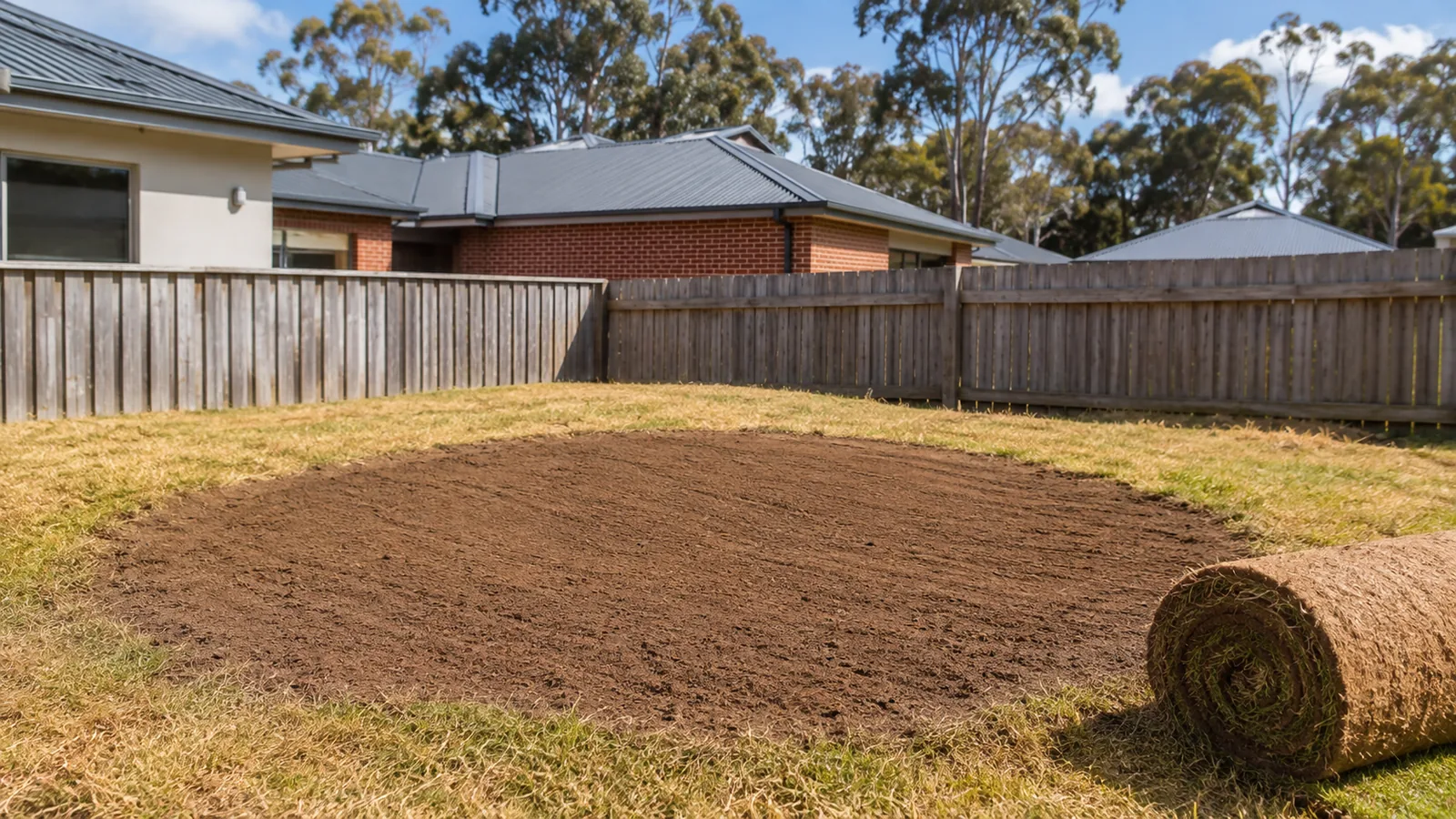
Turf laid over raw grindings goes yellow and sinks.
Turf is the case where the cheap version fails most visibly. Grind to 150mm, because turf roots occupy the top 100mm and rarely push past 150mm, then cart the grindings off and backfill the hollow with clean topsoil firmed to grade. Turf goes onto soil. That is the whole specification.
What happens if you skip the cart-away is two separate problems arriving together. The first is chemical. Fresh grindings are almost entirely carbon, and the soil bacteria that break them down need nitrogen to do it, which they pull from the surrounding soil. Turf rooting into that zone yellows within a season while the lawn either side of it stays green, and no amount of fertiliser fixes it neatly because you are feeding the decay as much as the grass. The second is physical. Grindings settle for 6 to 18 months, so the patch drops below the surrounding lawn, and once it is a dish it holds water after rain and the turf over it thins out further.
The result is a rectangle of pale sunken lawn exactly where the tree used to be, which is the shape people describe on the phone a year after the job. Carting the grindings off is $120 to $350 per stump and clean topsoil backfill is $80 to $220, so the extra is $200 to $570. A pallet of instant turf plus the labour to lay it is comfortably more than that, and doing it twice is more again.
One detail that gets missed: bring the topsoil slightly proud of grade, 20 to 30mm, and firm it. Backfill always settles a little, and turf laid dead level on fresh fill ends up marginally low. Detail on where the removed chip goes is on what to do with stump grindings.
A bed is the one case where some grindings can stay.
Grind to 250 to 300mm for a bed, because shrubs and perennials root deeper than turf and a bed gets dug over. This is also the only end state where keeping some of the spoil on site is reasonable, provided two conditions are met.
First, the grindings have to be mixed rather than left as a pocket of pure chip. Turned through the surrounding soil at a modest proportion, they behave like a coarse organic amendment and the nitrogen draw is spread thin enough to manage. Left as a concentrated lens in the bottom of the hole, they behave exactly as they do under turf. Second, they need time, ideally a season before anything goes in over them, and preferably a nitrogen source turned through with them.
What they should not be is packed against the roots of a new plant. Keep the plant hole itself clean soil, and put any retained grindings out at the edges of the bed or use them as a surface layer on a path or a back fence line where nothing is trying to grow. They are not the same product as arborist mulch: they carry soil, grit and stones, the particle size is all over the place, and they can carry pathogens from a tree that died of something. Fine as a path fill or a weed suppressant somewhere out of the way, poor as garden mulch.
If a new tree rather than shrubs is going in the same spot, this section does not apply and the grindings have to go. The reasoning is set out on how deep to grind a stump.
Paving needs the roots. A slab needs excavation.
For pavers, a sand-set path or the pad under a deck, grind to 300mm so the base is bearing on stable material, then deal with the surface roots. The roots are the larger half of this job and the half that gets left out of quotes. Tree roots sit in the top 300 to 600mm of soil and run out one to three times the radius of the old canopy, so a mature bottlebrush or liquidambar can easily have roots four or five metres from the trunk, directly under the path you are about to lay. Those roots are what lifts paving, not the stump. They are chased and cut along their run and priced by the metre at $60 to $150, which is covered on surface root removal. If the problem you are trying to solve is roots already lifting something, start at tree roots lifting a driveway.
For a concrete slab, a shed footing, a house extension, a pool shell or a retaining wall footing, grinding is the wrong method and there is no depth that makes it the right one. The root plate stays in the ground under a grind, that timber decays over five to fifteen years, the volume it occupied becomes a void, the fill above slumps into the void, and the slab loses support across a patch that can be half a metre across. Concrete does not bridge that. It cracks, and the crack runs to the nearest edge.
The correct method is excavation: the stump and root ball out whole, the stump off site as waste, and the hole backfilled with clean fill compacted in 150 to 200mm layers rather than tipped in loose. It costs two to four times what grinding the same stump would, which on a typical residential stump is the difference between the bands on the 2026 price guide and a four-figure number, and on a slab job it is not a choice. The comparison is set out on grinding versus full removal, and the building case in detail on stump removal before a shed or extension.
Six to eighteen months, and it is longer in peat than clay.
Anything backfilled with grindings settles, because the material was fluffed as it was cut and it compacts as it decays. The usual window is 6 to 18 months. Which end of that window you land on is mostly soil. In the heavy grey and brown clay across the Pakenham flats, backfill settles less and sooner, because the surrounding ground is dense and holds its shape. Down on the old swamp country around Koo Wee Rup, in peat and sand over clay, backfill keeps moving longer and drops further, and a mound that looked generous in autumn can be a dish by the following spring.
This is why the standard finish on a job where the grindings stay is to rake back and mound rather than level flush. A mound of 50 to 100mm above grade on a decent-sized stump is not a tidiness failure, it is the settlement allowance, and levelling it flat on the day guarantees a hollow later. If you want it flat on the day, the grindings have to leave and topsoil has to come in.
The same allowance applies to an excavated hole backfilled with clean fill. Compaction in layers gets most of it, but a small mound and a top-up at six months is normal practice and worth planning for rather than being surprised by.
Stumps come out before levelling, irrigation and lighting.
The stump work belongs early in a landscaping job, and it goes wrong when it is treated as a tidy-up at the end.
Access is the first reason. A grinder has to reach the stump, and the yard is at its most open before new paving, edging, raised beds and plantings go in. A stump that a 760mm machine could walk to in March can be unreachable in June without dropping a fence panel. Machines also should not be driven over finished surfaces. A tracked or wheeled grinder on unsupported pavers or a sand-set path breaks them, and while boards can be laid to spread the load it is slower, it costs more, and on a new surface it is a risk nobody needs to take. What fits where is covered on backyard access and machine size.
Services are the second reason, and the more expensive one. A grinder wheel works in exactly the top 300mm of soil, which is precisely where irrigation lines, garden lighting cable, private power out to a shed, telecoms lead-ins and occasionally a shallow gas lead-in all sit. Grinding before those go in means the only services in the ground are the ones a free Before You Dig Australia enquiry will show you. Grinding after they go in means cutting one, and the repair on a new irrigation main under finished turf costs more than the stump did. The full check is on underground services before stump grinding.
The third reason is levelling. Grinding produces a hollow and a volume of spoil, so final levels cannot sensibly be set until it is done. Grind, decide on the spoil, backfill, then level the whole area as one. Doing it the other way means levelling twice.
The practical sequence on most Pakenham and Officer estate blocks is: tree down, stump ground to the depth the end use needs, spoil dealt with, levels set, irrigation and lighting in, hard surfaces laid, then turf and planting last.
Landscaping questions we get asked.
Can I lay instant turf straight over stump grindings?
You can, and it is the most common way people waste the cost of a pallet of turf. Fresh grindings are almost entirely carbon, so the bacteria breaking them down take nitrogen from the surrounding soil, and turf rooting into that zone goes yellow within a season. The material also settles for 6 to 18 months, so the patch sinks below the surrounding lawn and holds water after rain. For turf the correct preparation is grinding to 150mm, the grindings carted off site, and clean topsoil backfilled and firmed to grade before the turf goes down.
How long should I wait between grinding and laying turf?
If the grindings have been removed and clean topsoil put in, you can lay turf the same week, because you are laying onto soil rather than onto decaying chip. If the grindings have been raked back and mounded, the honest answer is 6 to 18 months of settlement before the surface is stable, longer in the peat and sand around Koo Wee Rup and shorter in heavy Pakenham clay. Laying turf the same week over raw grindings is the mistake that produces the sunken yellow rectangle people ring about a year later.
Is grinding enough before laying pavers or a path?
Only if the surface roots are dealt with as well. Grind to 300mm so the paving base sits on stable material rather than chip, then chase and cut the major surface roots along their run, because it is the roots and not the stump that lift paving. Tree roots sit in the top 300 to 600mm of soil and reach out one to three times the radius of the old canopy, so they can run four or five metres under a path you are about to lay. Root chasing is separate work priced at $60 to $150 per metre of root run.
Can I pour a concrete slab or shed footing over a ground stump?
No. Grinding leaves the root plate in the ground and that timber decays over five to fifteen years, so the space it occupied becomes a void, the fill above slumps into it, and the slab loses support across a patch that can be half a metre wide. Concrete cracks from an unsupported patch to the nearest edge. For a slab, a shed footing, an extension, a pool shell or a retaining wall footing the stump has to be excavated and the hole backfilled with clean fill compacted in 150 to 200mm layers. That costs two to four times a grind, and it is not optional.
Where does stump work fit in a landscaping job?
Before levelling, and well before irrigation or garden lighting go in. A grinder needs to get to the stump, so it should come while the yard is still open and before new paving, edging or beds narrow the access. Doing it afterwards means either dropping a fence panel or working around finished surfaces, and running a machine over new pavers or a sand-set path is how those get broken. Cutting a new irrigation line or lighting cable is the other common outcome, since a grinder wheel works in exactly the top 300mm where those services sit.
Landscaping the spot? Tell us what is going on it.
Turf, a bed, pavers or a slab. Each one changes the depth, the spoil and whether the roots need chasing, so it belongs on the quote. Pakenham, Officer, Beaconsfield, Nar Nar Goon, Pakenham Upper, Koo Wee Rup and the wider Cardinia Shire.