Root removal, because the stump is often not the problem.
Lifting pavers, a humped driveway, a path with a step in it, a blocked drain. In every one of those cases the damage is being done by a root running sideways, and grinding the stump out does nothing about it. Chasing and cutting the run is separate work, priced by the metre, and it is what actually fixes the surface.
Shallow and wide, not deep.
The picture most people carry around is a mirror image of the tree, a taproot going down as far as the trunk went up. Real root systems are almost nothing like that. The overwhelming majority of a tree's roots sit in the top 300 to 600mm of soil, because that is where the oxygen and the water are, and they spread outward well past the edge of the canopy, commonly to one to three times the canopy radius. A gum with an eight metre spread can have working roots fifteen metres from the trunk.
Two consequences follow from that, and they explain most of what people ring about. The first is that the damage a tree does to hard surfaces happens at shallow depth, right where paths, paving sand beds, driveway subgrade and kerbs live. The second is that the root causing your problem may be nowhere near the trunk or the stump, so dealing with the stump and expecting the path to settle down is a wasted job.
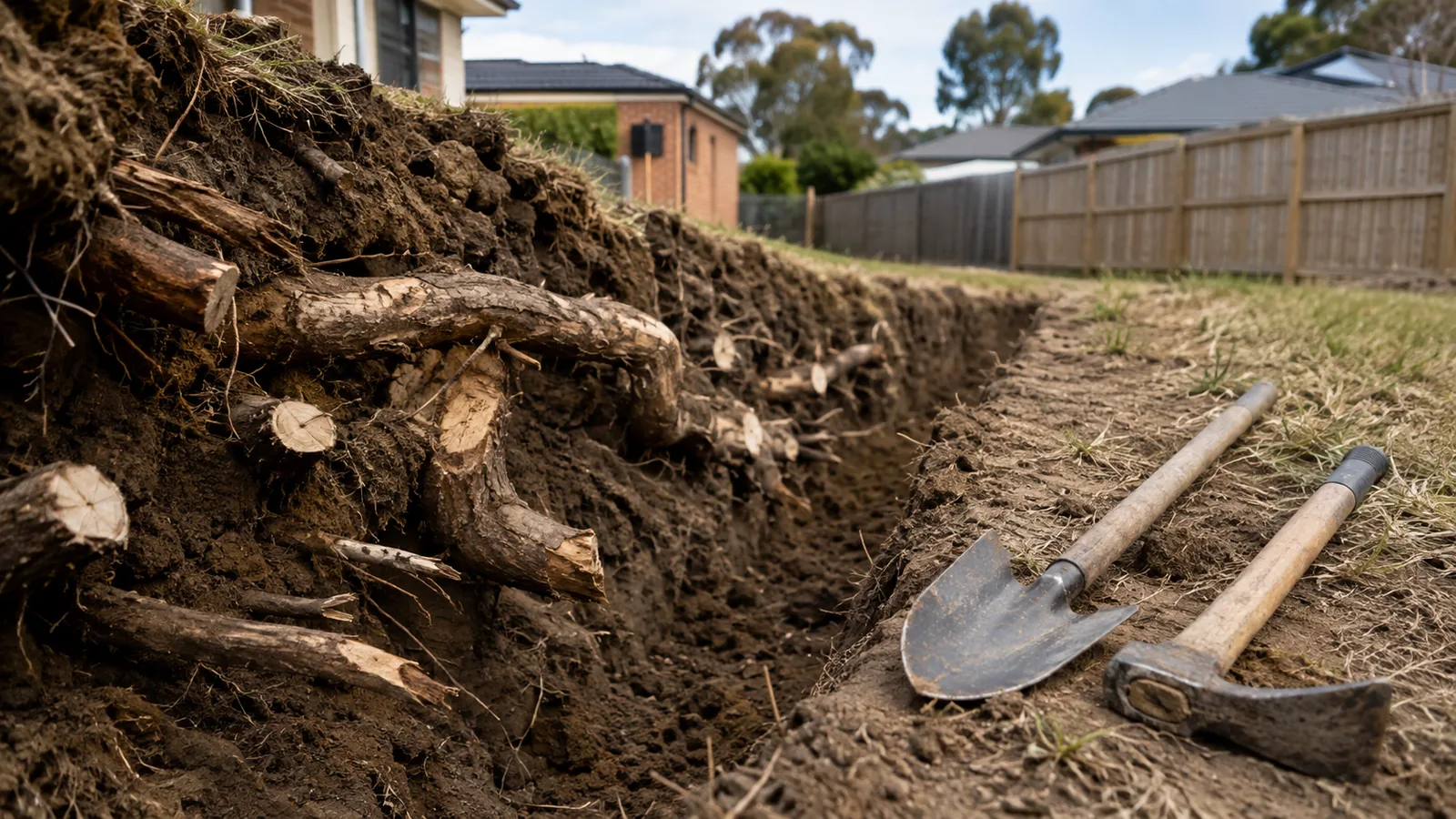
It also explains why this work is priced by the metre. Grinding a stump is a fixed object with a measurable diameter, so it can be quoted off a photo and a tape. A root run is an unknown length until it is followed, so it is quoted at $60 to $150 per metre of run and the total depends on how far the offending root travels under the thing you want fixed. Full pricing across all the stump services is on the 2026 price guide.
Grinding a stump versus chasing a root run.
People ask for stump grinding and describe a root problem often enough that it is worth setting the two side by side.
| Stump grinding | Root removal | |
|---|---|---|
| What it targets | The stump and the top of the root plate under it | A specific lateral root running away from the tree |
| How it is priced | By diameter at ground level, $180 to $1,500 plus | By length of run, $60 to $150 per metre |
| Machine | Carbide grinding wheel, worked from above | Trenching or hand excavation, then cut and lift the timber out |
| Ground disturbance | Confined to the stump footprint | A narrow open trench along the whole run |
| Fixes lifting paving | No | Yes, if the correct run is found and cut |
| Fixes a blocked drain | No | Only in combination with repairing the pipe |
The test: stand at the damage and look at where it runs, not at where the tree is. If the crack, the hump or the lifted paver follows a line heading away from a trunk or a stump, that line is a root and it is what needs cutting. If the damage is a general sinking or a soft spot directly over an old stump, that is a decomposition problem and it belongs to grinding and backfill instead.
Paving, paths, driveways, kerbs and the shallow services.
Hard surfaces fail over roots because a root thickens by adding a ring of wood each year and it has nowhere to go but up. A 40mm root under a sand-set path becomes a 90mm root in a decade, and the 50mm of growth has to come out of the paving. Pavers lift at one corner first, then a whole run goes out of level and the joints open. Concrete is more brittle so it goes straight to a crack, usually a curved one that traces the line of the root. Asphalt driveways hump rather than crack, which looks less serious and is often the more expensive repair.
Kerb and channel is the same mechanism with a council asset attached, and in the older parts of Beaconsfield where liquidambar, elm and oak were planted as street trees fifty years ago this is a routine sight. Around the newer Pakenham and Officer estates the trees are younger, and the surfaces going over them are newer, so the same problem is only starting to appear now that the developer-planted street trees have fifteen years of growth on them.
Under all of that sit the services. Irrigation lines, garden lighting, private power runs to a shed or a pool pump, telecoms lead-ins and sometimes shallow gas lead-ins all live in the same top 300mm that the roots occupy, which makes trenching along a root run the highest-risk work we do. Every job starts with a free Before You Dig Australia enquiry, and where plans show anything close we pothole by hand or bring in a private locator at $250 to $600 rather than guessing. There is a longer treatment of surface damage in tree roots lifting a driveway.
What roots really do to drains.
The common belief is that roots hunt for water and force their way into pipes. They do not. Roots grow where conditions favour growth, and a sound, sealed pipe gives them nothing to work with. What they respond to is a fault that is already there: a hairline crack in old earthenware, a rubber ring joint that has gone slightly open, a poorly bedded section that has settled. Moisture and nutrient leak into the soil around that fault, roots proliferate in the wet patch, and fine roots then enter through the existing gap and thicken inside the line.
The distinction matters when you are deciding what to spend. Cutting the roots and clearing the line gets the water running again and treats none of the cause, so on a living tree the same roots come back through the same fault, often inside two or three years. If the tree is staying, the durable answer is repairing or relining the defective section so there is nothing to leak, and cutting the roots at the same time so the pipe work is not immediately re-invaded. If the tree is going anyway, cutting the roots is enough, because dead roots do not regrow.
Cutting roots on a living tree has a real cost.
Where the tree is being removed anyway, root cutting carries no risk to the tree because there is no tree left to damage. Where the tree is staying, and most of these jobs involve a tree somebody wants to keep, the calculation changes.
- Anchorage. The large structural roots within a few metres of the trunk hold the tree up. Take several of them out on the same side and you have a tree that looks identical and is meaningfully less stable in a westerly, which is the direction our worst winds arrive from. That failure can be years away.
- Water and nutrient. The fine roots further out do the feeding. Removing a large share of them in one go shows up as canopy dieback and early leaf drop the following summer.
- Distance is the safety margin. The further from the trunk and the smaller the root, the less it matters. A 30mm root six metres out is a routine cut. A 200mm root a metre from the trunk of a mature gum is an arborist question and possibly a council one.
- It is maintenance, not a fix. A living tree regrows into the space you cleared. Expect to be back in three to seven years unless something stops the regrowth.
That last point is what pushes many of these jobs toward a root barrier. A barrier is a rigid or geotextile sheet set vertically in a trench between the tree and the surface you are protecting, deep enough to sit below the working root zone, so new growth is deflected down and away rather than under your slab. It costs more than a round of root cutting and it means opening a trench along the line, which is why the sensible time to install one is while the ground is already open for the root work, for new paving, or before a driveway is poured. Where the tree itself is the problem and it is coming out, the whole question moves across to full stump and root ball removal.
Questions about root work.
Does grinding the stump get rid of the roots?
No. Grinding takes out the stump and the top of the root plate directly under it, and everything running away sideways stays exactly where it is. That is fine if the roots are not causing you a problem, because they die once the tree is gone and break down over roughly five to fifteen years depending on species and soil. It is not fine if the reason you rang is a lifting path or a humped driveway, because the roots doing that damage can sit three, five or eight metres from the stump and grinding never goes near them. Root work is a separate job priced separately.
How much does surface root removal cost?
Between $60 and $150 per metre of root run in 2026. It is priced by the metre rather than by the root because the work is following a run: opening the ground along its length, cutting the root cleanly at both ends of the section being taken, getting the timber out, then backfilling and treading the trench back down. A single 200mm root under a path can be two metres of work or eight, and the difference is length, not thickness. Depth, whether the run passes under paving or concrete, and what services sit alongside it move the rate within that band.
Do tree roots break sewer and stormwater pipes?
Roots do not seek out and crack sound pipe. What happens is that an old pipe already has a hairline crack or a slightly open joint, moisture and nutrient leak into the surrounding soil, and roots grow toward that patch and then in through the existing gap. Once inside they thicken and block the line, and they can widen the original fault considerably. The practical result is the same, a blocked drain, but the fix is different: cutting the roots without repairing or relining the pipe means the same roots return, usually within a couple of years.
Can you cut roots on a tree we want to keep?
Sometimes, and it needs care rather than a chainsaw. Roots do two jobs, they anchor the tree and they collect water and nutrient, and the large ones close to the trunk carry most of the anchorage. Cutting several of those on one side leaves a tree that looks unchanged and is measurably less stable in wind, and the failure can come years later. As a general rule the further from the trunk and the smaller the root, the safer it is to cut. For a significant tree that is staying, get an arborist to assess it before anything is severed, particularly on gums.
Is a root barrier better than cutting roots again in a few years?
If the tree is staying and the damage is ongoing, usually yes. Cutting a root run gives you a few clear years and then the tree regrows into the same space, so on a living tree root cutting is maintenance rather than a fix. A barrier is a rigid or geotextile sheet set vertically in a trench between the tree and whatever you are protecting, deep enough to reach past the root zone, so new growth is deflected down and sideways instead of under your slab. It costs more once and it means opening a trench, which is best done while the ground is already open.
Root work across the Cardinia Shire.
Send a photo of the damage, not just the tree.
One picture along the line of the crack or the lifted paving tells us more than a photo of the trunk. With that and a rough length we can put a number on the run before anyone drives out.