In Beaconsfield, it is usually a root problem, not a stump problem.
Older blocks, mature canopy, and stumps that were big trees for forty years before anyone touched them. Liquidambar, elm, oak and some serious gums. The measured diameter tells you half the story here, because the root flare and the surface roots running out under the lawn are frequently the larger part of the job.
Established exotics do not behave like estate gums.
A fifteen year old gum in a new estate is a tidy stump. Round-ish, a modest flare, and what you measure across the cut face is close to what the machine has to remove. A sixty year old liquidambar on a Beaconsfield block is a different object. Big established exotics put out a broad, buttressed flare that spreads out from the trunk before it turns down, and the flare is frequently half a metre or more wider on each side than the trunk you are measuring.
That flare has to come out. If you asked for 300mm because a garden bed is going in, 300mm means 300mm across the whole footprint of the flare, not just under the centre of the trunk. So a 600mm measured stump in Beaconsfield can mean clearing a footprint closer to a metre and a half across. That is the honest reason a Beaconsfield job often prices above the band its diameter suggests, and it is worth knowing before you compare three quotes and pick the one that ignored it.
Species matters too, and the mix here is different from the estates. Elm and oak are dense and hold grit in the bark fissures, so teeth wear. Liquidambar is easier cutting but sends out an unusually wide, shallow surface root network. Elm has one extra trait worth naming: it can push suckers from its root system, so grinding an elm stump does not necessarily end the shoots coming up through the lawn. Alongside all of that, the older north side of Beaconsfield has genuine mature gums, and a gum root plate is a different cutting job again. Species by species detail is in gum, palm and pine stump removal.
Roots under lawns, paths and driveways.
More Beaconsfield enquiries are actually about roots than about stumps, even when the person ringing says stump. The pattern is consistent: a large tree stood in a lawn or near a driveway for decades, it came down or is coming down, and what is wrong with the property is a lifted paver, a humped concrete path, a cracked driveway edge or ridges running through the turf.
Grinding the stump does nothing about any of that. Tree roots sit overwhelmingly in the top 300 to 600mm of soil, because that is where the air and water are, and they extend well past where the canopy line used to be, often one to three times the canopy radius. On a mature elm or oak that means the roots doing the damage can be eight or ten metres from the trunk, running under a path that was laid around them years ago.
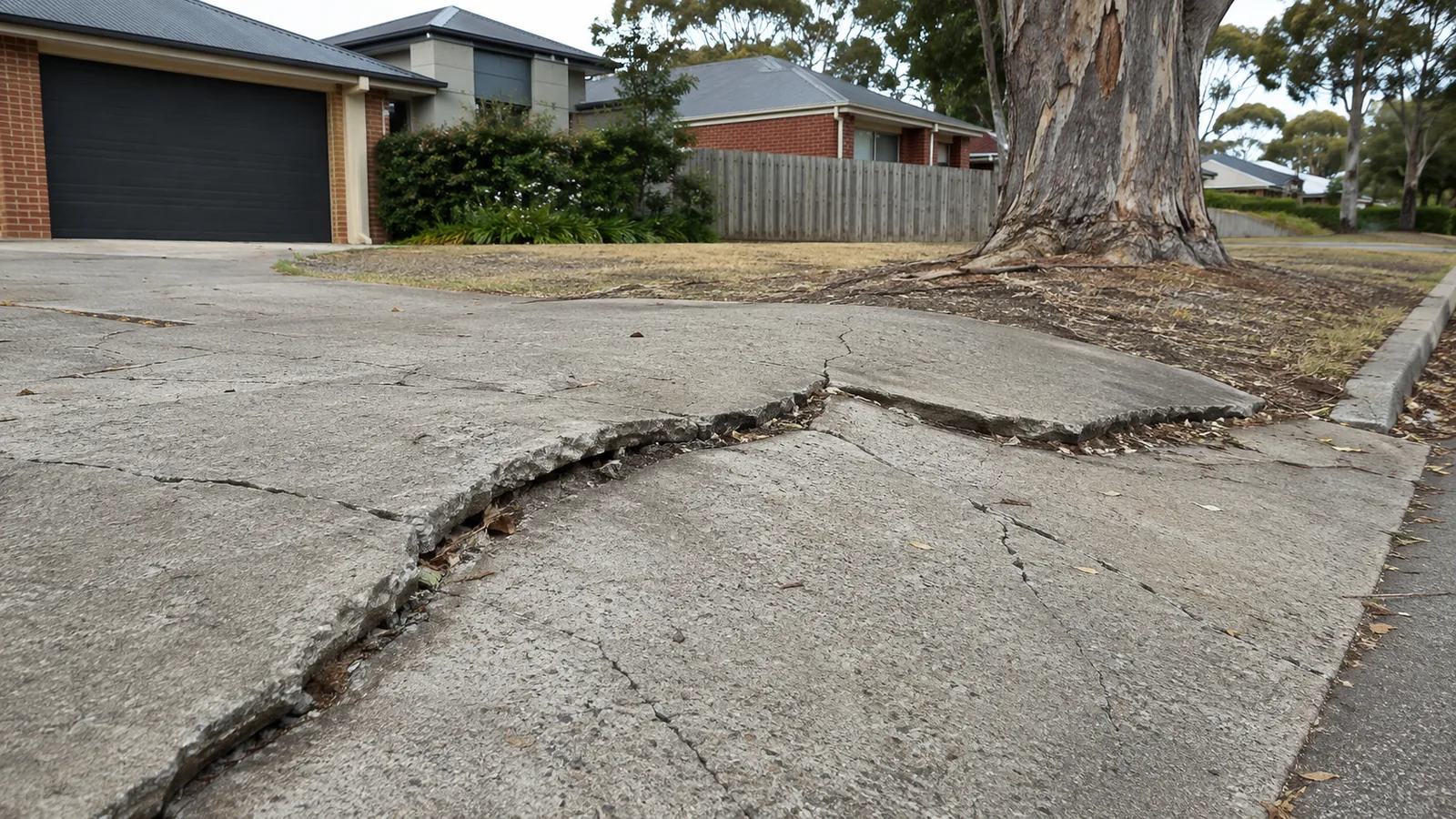
Root chasing is priced separately from the stump, at $60 to $150 per metre of root run, because it is separate work: the run gets exposed along its length and cut back rather than being ground where it happens to surface. Whether it is worth doing depends on what is going over the top afterwards. Under lawn that is being reseeded, often not. Under new paving, almost always, because it is the roots that lift pavers rather than the stump. The mechanics of it are in surface root removal, and the hard surface case is worked through in tree roots lifting a driveway.
Clay loam on the rise, and why that helps.
Beaconsfield sits on the transition between the flat clay country to the south and the hills to the north. The ground is clay to clay loam and it drains better than the Pakenham and Officer flats do, because it is on the rise rather than on the plain. For stump work that is straightforwardly good news.
Better drainage means fewer weeks of the year when a tracked machine would leave ruts across a lawn, so there is more of the calendar available. It also means the grindings rake back cleanly instead of turning into the sticky paste that wet Pakenham clay produces. And clay loam holds a backfill mound about as well as heavy clay does, so settlement over the first six to eighteen months is at the mild end, in the range of fifty to eighty millimetres rather than the dish you get in Koo Wee Rup peat.
The counterweight is volume. A ground stump yields two to three times its own volume in chip, and Beaconsfield stumps are big, so the heap is big. On an established garden where the owner does not want a mound of raw grindings sitting in the middle of a lawn, cart-away at $120 to $350 and clean topsoil backfill at $80 to $220 is a more common choice here than it is on acreage. Raw grindings also rob nitrogen from anything trying to grow in them, which is why turf laid straight over them goes yellow.
Room to work, more to protect.
Access in Beaconsfield is generally the opposite of the estate problem. Blocks are larger, driveways are wider, side setbacks are more generous, and there is usually room to bring a machine around and circle the stump. Being able to sweep the cutting wheel across the face from every angle is the single biggest factor in how long a stump takes, so on raw access this is easier country than Officer.
What replaces the access problem is everything on the way in that has been there twenty or thirty years and cannot be replaced. Mature hedging that will not grow back evenly if it gets stripped. Established garden beds. A brick or bluestone edge. A paved path laid in a size and colour nobody stocks any more. A tracked machine does not go over unsupported pavers or a sand-set path, so where that is the only route we lay boards, and where the route runs past something worth protecting, screens go up before the wheel turns.
Debris screening matters more on these jobs than most people expect. A grinder throws chip hard enough to mark render, pit car paint and take the leaves off one side of a hedge, and on an established block the neighbour's property is usually well within range. That is set-up time, and it is part of why a large Beaconsfield stump is not a thirty minute job even when the cutting itself would be.
Worth asking before you book: what is going on the spot afterwards. Lawn wants 150mm, a garden bed 250 to 300mm, paving 300mm plus the surface roots along their run. If a shed, an extension or a slab is going over the spot, do not grind at all, because a rotting root plate under concrete becomes a void and a void becomes a crack. On a Beaconsfield block with a big root plate that is a real risk rather than a theoretical one. The full depth table is in how deep to grind a stump.
Standing trees, not stumps.
Beaconsfield has enough mature canopy that the permit question comes up regularly, and the line is clear. Cardinia Shire's Tree Protection Local Law applies to living trees, with the trigger being a trunk circumference of 110cm or more measured at 1.4m above the ground, roughly 35cm in diameter. A lot of the established exotics on these blocks are well past that. Indigenous remnant species are protected at any size, including River Red Gum, Yellow Box, Manna Gum, Messmate Stringybark and Blackwood, and the semi-rural north side has real remnants standing in private gardens.
Grinding a stump that has already been cut is not normally a permit matter. If the tree is still up, sort that first, and check the current requirements and fees directly with Cardinia Shire, because they change. Penalties for removing a protected tree without approval are serious. Where a title sits inside a planning overlay we look before we quote rather than after.
Questions from Beaconsfield.
Why does a Beaconsfield stump cost more than the same size stump in a new estate?
Because the diameter at the cut face is not the whole job. A mature liquidambar, elm or oak has a root flare spreading well past the visible trunk, sometimes half a metre or more each side, and the whole flare has to come out to reach the depth you asked for. A 600mm measured stump can mean clearing a footprint closer to a metre and a half. Add surface roots running out under the lawn and you can be paying for a metre band of root chasing at $60 to $150 per metre on top of the stump price.
Do I have a stump problem or a root problem?
In Beaconsfield it is more often roots, and the test is simple. If what bothers you is a lifted paver, a humped path, a cracked driveway edge or ridges through the lawn, that is roots, and grinding the stump alone fixes none of it. Roots sit overwhelmingly in the top 300 to 600mm and extend one to three times the radius of where the canopy used to be, so on a big established exotic the damage often shows up eight or ten metres from the trunk. The stump is where the tree was. The roots are where the problem is.
Can you grind a big stump without wrecking an established garden?
That is the main constraint on most Beaconsfield jobs. Getting to the stump is usually easier than on an estate block, but there is far more worth protecting on the way: mature hedging, established beds, a brick or stone edge, a paved path nobody can match. We do not run a tracked machine over unsupported pavers or a sand-set path, so where that is the only route we lay boards. Debris screens go up as a matter of course, because a grinder throws chip hard enough to mark render, pit paint and strip a hedge.
Are the trees in Beaconsfield covered by the Cardinia tree protection rules?
Some of them, depending on the tree rather than the suburb. The Tree Protection Local Law covers living trees with a trunk circumference of 110cm or more at 1.4m above ground, roughly 35cm diameter, and plenty of established Beaconsfield exotics are well past that. Indigenous remnants are protected at any size, including River Red Gum, Yellow Box, Manna Gum, Messmate Stringybark and Blackwood, and the older north side has genuine remnants in gardens. None of it applies to a stump already cut. Check current requirements with Cardinia Shire before a standing tree comes down.
Also working across the shire.
Send a photo from a few metres back.
On a Beaconsfield job the flare and the surrounding garden matter as much as the diameter, so one wide photo plus a tape measurement across the cut face is usually enough for a firm price.