How deep does a stump actually need to be ground?
There is no standard depth, and anyone who quotes you one without asking what is going on the spot is guessing. The number is set by what goes over the top: 150mm for turf, 250 to 300mm for a garden bed, 300mm plus roots for paving, and excavation rather than grinding for anything with a footing. Here is the reasoning behind each one.
Depth is a brief, not a setting on the machine.
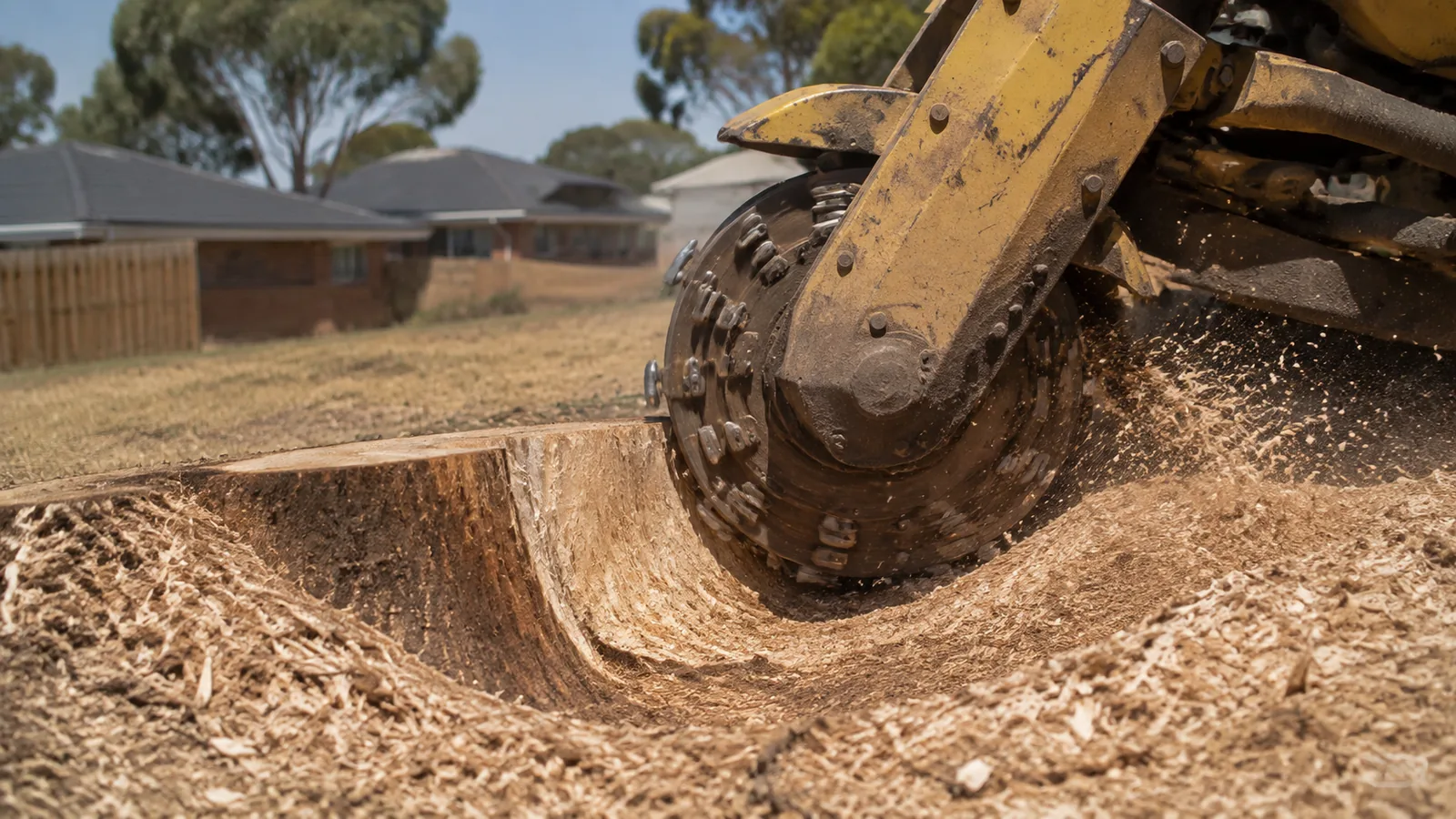
A stump grinder does not have a depth dial. The operator lowers the wheel, sweeps it across, drops it again, and stops when the job is done. Where "done" sits is a decision, and if nobody takes a brief, the decision defaults to whatever is quick, which is usually 100 to 150mm.
That is genuinely enough for some jobs and nowhere near enough for others, and the difference does not show for a year or more. Nearly every complaint in this trade traces back to the same sequence: the stump was ground to whatever depth the machine reached, nobody asked what was going on top, and eighteen months later there is a soft patch, a sunken paver or a dead replacement tree. The grinding was fine. The brief was never taken.
Three things determine the requirement, and they are worth separating because people mix them up. First, the root depth of whatever you are planting. Second, the subgrade requirement of whatever you are laying. Third, the footing depth of whatever you are building. Turf is the first kind of question, paving is the second, a shed is the third, and each gives a different answer.
Grind depth by end use.
Depths are measured below finished ground level, not below the top of the stump. Tell us which row you are in when you ask for a price and the quote is a specification rather than a number.
| What is going on the spot | Depth below grade | Why that number |
|---|---|---|
| Lawn or instant turf | 150mm | Turf roots do not go deeper than that, so anything more is paying a machine to move soil |
| Garden bed or a new shrub | 250 to 300mm | New plants need clean root room, and shrub roots work deeper than turf |
| Replanting a tree in the same hole | 300mm or more, spoil removed | Raw grindings left in the hole are the leading cause of a replacement tree failing |
| Pavers, sand-set path, decking | 300mm plus surface roots | It is the roots that lift pavers, not the stump, so the stump alone is half a job |
| Concrete slab, shed, extension, footing | Do not grind, excavate | A rotting root plate becomes a void, and a void under concrete becomes a crack |
| Fence line or retaining wall | Depends on post or footing depth | A post bearing on an old root plate will move as the timber decays beneath it |
Practical machine limit. A residential grinder works comfortably to roughly 300 to 450mm below grade, depending on the machine and how much room there is to swing the wheel. Anything that genuinely has to be clear of timber below that is an excavation job, not a deeper grind, and the difference between the two methods is set out on grinding versus full removal.
The reasoning behind each depth.
Lawn at 150mm. Turf roots occupy the top 100mm and rarely push past 150mm even once established. Grind to 150mm below grade, get the grindings out, put clean topsoil in, and the turf has soil to root into and nothing decaying immediately beneath it. Grinding to 300mm for a lawn is money spent moving dirt, and it makes the backfill problem bigger rather than smaller because you now have a deeper hollow to fill.
Garden beds at 250 to 300mm. Shrubs and perennials root deeper than turf, and a garden bed is usually mounded or dug over anyway, so the extra 100 to 150mm costs little and buys clean root room. It also means the bed can be turned over with a fork without hitting timber, which matters if you are the sort of gardener who moves plants around.
Paving at 300mm plus roots. A sand-set paver sits on 80 to 100mm of compacted road base over subgrade, so the top 200mm needs to be stable material rather than decaying chip. But the depth is the smaller half of this job. What actually lifts paving is the surface root system running out sideways, sometimes four or five metres from where the trunk was, and grinding the stump does nothing about those. They have to be chased and cut along their run, which is priced by the metre and covered on surface root removal. The same applies to a path, a driveway edge or the pad under a deck.
Fence lines and retaining walls, which depend. A fence post is a small footing. If the post hole lands on the old root plate, the post is bearing on timber that will be gone in a decade, and the fence will lean. The depth you need is the depth of the post hole plus a bit, so measure the hole first. On a retaining wall the same applies with a lot more load involved, which usually pushes the job into excavation.
What actually goes wrong, and when.
Under-grinding never fails immediately. That is the difficulty with it, and the reason the cheapest quote so often looks like the right one on the day.
Under lawn, a stump left at 100mm gives you a soft patch. The chip and the remaining timber break down, the ground drops 30 or 40mm over a couple of years, and the grass over it browns off first in a dry January because there is decaying woodchip rather than soil holding moisture in the root zone. You top it up, and it drops again.
Under pavers, one paver drops below its neighbours. It is always one, and it is always the one directly over the old stump. Relaying it means lifting the surrounding pavers, digging out the softened material and rebuilding the base, which costs more than grinding to the correct depth would have in the first place.
A replacement tree planted into shallow-ground spoil usually survives the first summer and then sits still. Fresh grindings have a very high carbon to nitrogen ratio and pull nitrogen out of the surrounding soil while they decay, so the young tree spends two or three years competing for what it needs. Some die outright. Most just never get going, and the owner assumes it was a bad plant.
Under a slab there is no shallow depth that works, which is the point of the excavation row in the table. A cracked slab is the one failure on this list that cannot be quietly fixed later. The full case is on stump removal before a shed or extension.
Depth you do not need is money spent moving soil.
Going deeper is not automatically safer. Below roughly 300mm the stump has narrowed and the root plate has thinned, so most of what the wheel is chewing through is soil and the occasional rock. A grinder is a slow and expensive way to dig. On the rocky ground and basalt float up at Pakenham Upper it is worse again, because a hidden stone at 250mm damages teeth for no gain at all.
Extra depth also makes the finish harder. Every 100mm of additional depth on a 600mm stump produces a noticeably larger hollow and a larger volume of spoil, and a ground stump already yields two to three times its own volume in chip because the material fluffs as it is cut and picks up soil on the way. Deeper means more chip to rake back, more mound to settle, or more material to cart away and more topsoil to bring in.
So the target is the depth the end use requires and not a millimetre more. If the answer to what is going on top is honestly "nothing, it is just a corner of the yard", 150mm is plenty and the money saved is real. What happens to the spoil either way is covered on what to do with stump grindings, and the add-on prices are on the 2026 price guide.
Putting a new tree in the same hole.
This is the one row in the table where the spoil decision matters more than the depth decision, and it is the request we most often have to talk people out of doing cheaply. A replacement tree going into the same position needs 300mm or more of grinding and the grindings taken away, with clean topsoil backfilled in their place. Raking the chip back into the hole and planting into it is the single most common cause of a replacement tree failing.
The mechanism is nitrogen. Fresh grindings are almost all carbon, and the soil bacteria that break them down need nitrogen to do it, which they take from the surrounding soil. For the first two or three years the pocket of chip is a nitrogen deficit, and a young tree with its entire root ball sitting inside that deficit does not grow. Feeding it helps a little and does not solve it, because you are feeding the decay process as much as the tree.
There is also the physical side. Grindings are loose and they settle over 6 to 18 months, more in the peat and sand down around Koo Wee Rup and less in the heavy clay across the Pakenham flats. A tree planted into settling material ends up sitting lower than it started, sometimes with the graft or the root collar buried, which is its own slow problem.
The easiest answer, if the design allows it, is to offset the new tree one to two metres from the old position and plant into undisturbed soil. It costs nothing, avoids the old root plate entirely, and the new tree gets a normal start. Where the position is fixed, pay for the spoil removal and the clean backfill. On a single stump that is $120 to $350 to cart the grindings and $80 to $220 for topsoil, which is cheap against replacing a failed advanced tree twice.
Grinding removes the stump and the top of the root plate. That is all.
No matter what depth you choose, grinding takes out the stump itself and the upper part of the root plate directly beneath it. Every lateral root running away from that plate stays where it is. On a mature tree those roots sit in the top 300 to 600mm of soil and extend one to three times the radius of the canopy that used to be there, so a gum that shaded half the yard has roots under most of it.
Once the tree is gone those roots die and break down over roughly five to fifteen years, faster in warm moist soil and slower in dry clay, faster in softwoods and slower in dense hardwoods like red gum and ironbark. Under lawn and garden that process is invisible and does no harm. It matters in exactly two situations: where a load-bearing surface is going over the top, and where the species suckers, because poplar, some willows, robinia and a few wattles can push new shoots from live root fragments even after the stump is gone.
The practical version, when you are booking: tell us the end use, we set the depth to suit it, and we tell you honestly whether the roots also need chasing or whether the stump alone finishes the job. Most of the time it does. The method itself is described on the stump grinding service page, and if you are laying turf or a hard surface over the spot, the preparation sequence is on grinding before turf or concrete.
Depth questions we get asked.
How deep should a stump be ground?
There is no single correct depth, which is why the question is worth asking before you book rather than after. The depth is set by what is going on top of the spot. Lawn or instant turf needs 150mm below grade, because turf roots do not go deeper than that. A garden bed or a new shrub wants 250 to 300mm so the plant has clean root room. Pavers, a sand-set path or decking want 300mm plus the surface roots taken out along their run. Replanting a tree in the same hole wants 300mm or more with the spoil removed. If a concrete slab or a footing is going over the spot, grinding is the wrong method entirely.
What happens if the stump is not ground deep enough?
It depends on what went over the top, and the failure is always slow. Under lawn you get a soft spot that sinks a little each year and a patch of grass that browns off in summer because there is chip rather than soil holding moisture. Under pavers you get one paver that drops below its neighbours as the timber beneath it decays. A replacement tree planted into shallow-ground spoil struggles and often dies, because the grindings rob nitrogen as they break down. Under a slab the timber becomes a void and the void becomes a crack. None of it shows up in the first year.
Can you grind a stump too deep?
You can pay for depth you do not need, which is the same thing as wasting money. Below about 300mm you are mostly moving soil rather than timber, because the stump narrows and the root plate thins out, and a grinder is an expensive way to dig a hole. Every extra 100mm also produces more spoil to deal with and a deeper hollow to backfill. There is a practical machine limit too, generally 300 to 450mm below grade for a residential grinder. If your job genuinely needs to be clear of timber below that, excavation is the correct method rather than more grinding.
Does grinding remove the whole root system?
No, and no contractor can honestly claim it does. Grinding removes the stump and the top of the root plate directly beneath it. Every lateral root running out from that plate stays in the ground, and on a mature tree those roots sit in the top 300 to 600mm of soil and reach out one to three times the radius of the old canopy. They die once the tree is gone and break down over roughly five to fifteen years depending on species and soil. That is harmless under lawn and garden. It is the reason grinding is the wrong method under a slab.
How deep do you grind if I want to plant a new tree in the same spot?
300mm or more, and the spoil has to come out rather than being raked back in. This is the one case where backfilling with grindings will cost you the new tree. Fresh grindings have a very high carbon to nitrogen ratio, so as they break down they pull nitrogen out of the surrounding soil, and a young tree competing for nitrogen in a pocket of decaying chip is a tree that sits still for two years and often fails. Cart the grindings off, backfill with clean topsoil, and plant into soil. Offsetting the new tree a metre or two from the old position is easier again.
Tell us the end use and we will set the depth to match it.
Turf, garden bed, paving, a new tree or a slab. The answer changes the job, so it goes on the quote. Pakenham, Officer, Beaconsfield, Nar Nar Goon, Pakenham Upper, Koo Wee Rup and the wider Cardinia Shire.