What is under the stump, and how to find out before the wheel does.
A stump grinder works in the top 300mm of soil. That is precisely the depth where irrigation, garden lighting, private power to a shed and telecoms lead-ins live, and almost none of it appears on any plan. Here is what a free Before You Dig Australia enquiry gives you, what it does not, and when to spend money on a locator.
Before You Dig Australia, and what it actually returns.
Before You Dig Australia, universally shortened to BYDA, is the national referral service for underground infrastructure. It was Dial Before You Dig for years, run state by state, and the services unified nationally on 1 July 2022 under the current name. The phone number stayed the same. You lodge online at byda.com.au or you ring 1100, you draw or describe the area you will be working in, and the registered asset owners whose infrastructure falls inside that area email you their plans.
It is free. There is no charge to lodge and no charge for the plans that come back. Turnaround is normally a couple of business days, which is the practical reason to lodge it when the job is booked rather than the morning the machine is due. On a job near a boundary or a meter we lodge it as standard, and you are welcome to lodge one yourself as well since it costs nothing and you get the plans directly.
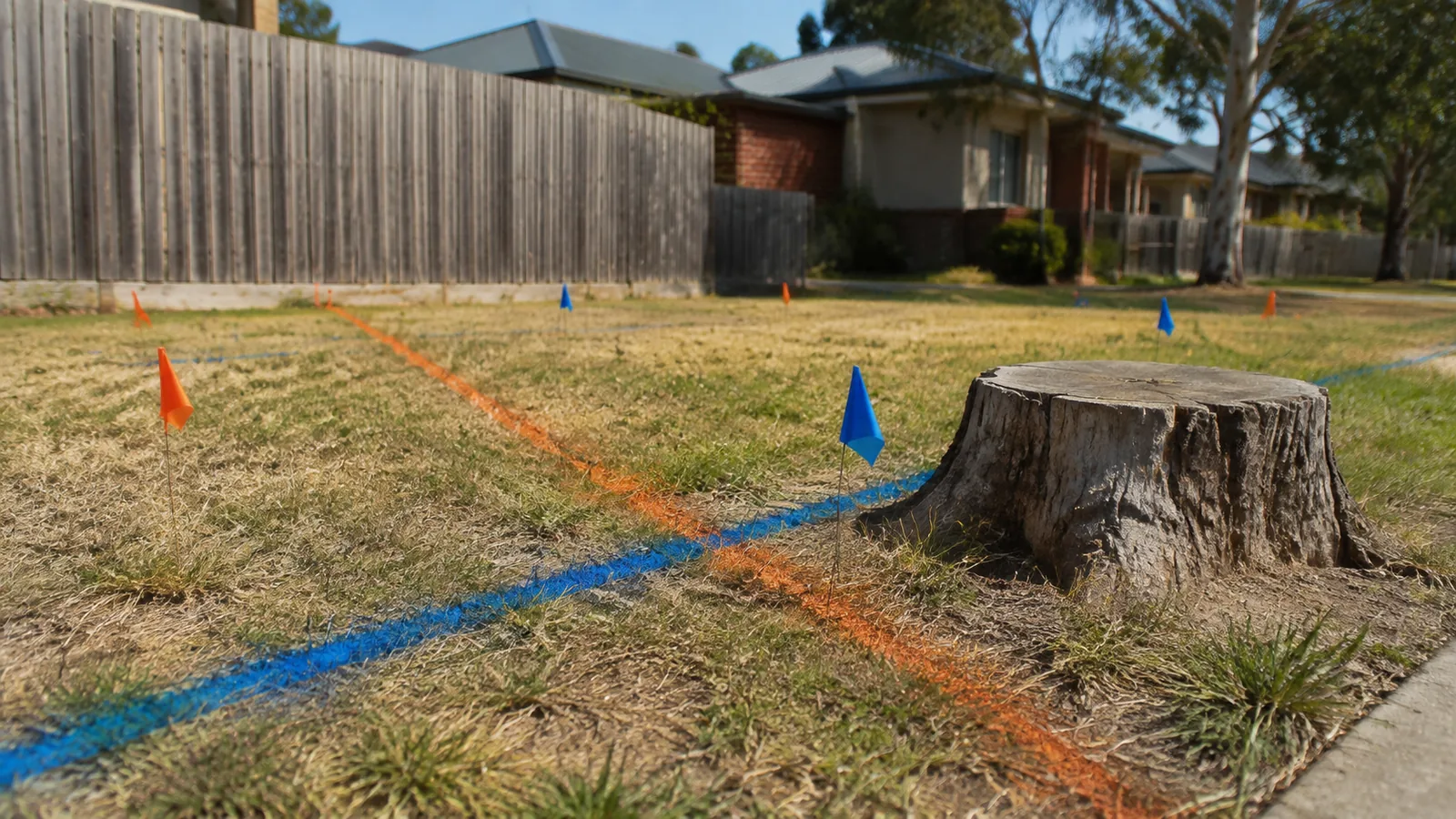
What arrives is a set of drawings from each asset owner: the electricity distributor, the water authority, the gas network, the telecommunications carriers, and whoever else has registered infrastructure in that block. Each plan shows the approximate position of that owner's assets. It will tell you that a water main runs along the nature strip and roughly where the property connection leaves it. It will not tell you that the connection dog-legs around a tree root at 400mm depth halfway up your front lawn.
Plans are not a mark-out.
This is where people get caught. BYDA is a referral service. It puts you in contact with the asset owners and passes on their records. Nobody comes to your property, nobody sweeps the ground with a locator, and nothing gets painted on your lawn. The word "approximate" on those plans is doing real work.
Asset plans are drawn for network management, not for excavation. They were digitised from older records, sometimes from surveys done before the estate around them was built, and horizontal accuracy of a metre or more is normal. Depth is frequently not shown at all, and where it is shown it is design depth rather than as-built depth. Ground gets cut and filled during a development, so a service laid at 600mm in 2004 can sit at 300mm today because the landscaper regraded the yard.
The correct use of the plans is as a map of where to be careful, not as a map of where things are. If a plan shows an asset anywhere near your stump, the next step is either potholing by hand to physically expose it, or a private locator. Treating a BYDA response as a guarantee that the ground is clear is the mistake that puts a grinder wheel through a service.
The practical rule on a stump job: the free enquiry tells you what registered infrastructure exists in the area. It cannot tell you about anything a previous owner buried, and on a residential block the previous owner is usually the one who buried the thing you are about to hit.
The wheel works in the top 300mm. So does everything shallow.
Trenching for a new sewer connection goes deep and slow, and the crew potholes as they go. Stump grinding is the opposite. The wheel sweeps across the face and the whole job happens in the top 150 to 300mm, over an area a metre or two wide, and it happens fast. That shallow band is exactly where the services that never made it onto any register were laid, because whoever laid them was digging by hand and dug the minimum they could get away with.
Mains infrastructure is generally deeper and better recorded. The shallow layer is private, informal and undocumented. On a typical Pakenham or Officer block, what realistically sits in the top 300mm and will not be on a BYDA response includes:
- Garden irrigation. Poly line and solenoid wiring, often laid at 100 to 150mm by a landscaper or the owner. The most commonly hit thing on any stump job.
- Garden and pool lighting. Low voltage cable, sometimes barely covered, running to a light beside the very tree that has now been cut down.
- Private power to a shed or studio. A sub-circuit from the switchboard out to a rear shed. It is real mains voltage, it is on nobody's plan, and it is often shallower than it legally should be.
- Pool pump and chlorinator wiring. Plus the pool's own water lines, which loop around in ways nobody records.
- Telecoms lead-ins. The copper or fibre from the pit to the house. These are frequently shallow, often trenched by hand, and the pit is usually near a boundary.
- Private water lines. A run out to a garden tap on the far fence, a tank line, a stock trough line on an acreage block.
- A shallow gas lead-in. Less common, but it happens on older connections, and it is the one nobody wants to find with a grinder.
- Old unmapped septic and stormwater. Earthenware or PVC from a period when nothing was recorded. Common on the older Beaconsfield blocks and the semi-rural properties around Nar Nar Goon and Pakenham Upper, including absorption fields whose location is now folklore.
None of these are on the plans, and all of them are in the exact band the wheel works in. This is the reason the process below exists, and it is why an experienced operator spends ten minutes walking the yard before starting a machine that would take forty minutes to do the whole job.
Private locating: $250 to $600, and when it is worth it.
A private locator turns up with an electromagnetic cable locator and usually ground penetrating radar, sweeps the area, and paints the runs on the ground. Unlike BYDA, that is an actual physical mark-out and it will find unregistered private services that no plan shows. It runs $250 to $600 depending on the area covered and the travel.
On a stump in the middle of a back lawn, well clear of the house, the meter and the boundary, that money is not proportionate. A BYDA enquiry and a careful site walk is the right level of care and we will tell you so rather than upselling it. The three situations where a locator genuinely earns its fee:
- The stump is within a couple of metres of a boundary, a meter, a pit or the house. That is where every lead-in converges. See below on why this is the highest-risk spot on any block.
- The plans show an asset in the area and cannot be more precise. If a plan puts a service somewhere in a three metre band and your stump is in that band, guessing is not a plan.
- There is visible evidence of private runs. A powered shed, a pool, garden lighting, a tap on a far fence, a sprinkler head in the lawn. Something went from A to B underground and the route is unknown.
There is also a cheaper middle option that suits most jobs: potholing. Digging a small hole by hand, or with a hydro-excavation nozzle, to physically expose the service before the machine starts. It costs a bit of time rather than a few hundred dollars, and on a single suspected run it is often the sensible answer. Costs for the optional extras on a job, locating included, are set out on the 2026 price guide.
The sequence we actually follow.
Lodge the BYDA enquiry
Free, online at byda.com.au or by phone on 1100, lodged when the job is booked so the plans are back before the machine is. It is done as standard on anything near a boundary, a meter, a pit or a service run.
Walk the site and read the evidence
Where is the meter box, where is the telecoms pit, where is the switchboard. Does the shed have power. Is there a tap on the far fence, sprinkler heads in the lawn, a garden light near the stump, a pool. Every one of those means something runs underground between two points, and the straight line between them is the line to avoid. The same walk settles the access question, which is worth doing yourself first using the backyard access checklist.
Ask you what you know
You know your block better than any plan. Whether anything has been trenched since you moved in, where the old septic used to be, which corner floods. Two minutes of that is worth more than a page of drawings.
Pothole anything uncertain
Where a suspected run crosses the work area, expose it by hand first. Where the uncertainty is broader than one line, that is the point at which a private locator is the right call rather than a luxury.
Screens up, then cut
Debris screens go up before the wheel turns, to keep chip off windows, render, glass and the neighbour's car. Then the stump gets ground to the depth the next job needs, which is a decision covered on how deep to grind a stump.
What happens when a service is hit, and where the liability sits.
Hitting an irrigation line is an inconvenience and a fitting. Hitting a live electrical cable is a serious safety incident, and it is treated as one: everyone off the ground, nothing touched, the network operator called. Hitting a gas lead-in means the area is cleared and the gas network's emergency line is called immediately. These are not situations to improvise in, and the correct response is always to stop and call the asset owner rather than to inspect the damage.
On liability, the general position is straightforward. Damage to a registered asset that appeared on the plans, or that reasonable care would have located, sits with the contractor. That is why the enquiry, the site walk and potholing are done as routine rather than on request, and why a contractor who skips them is carrying a risk they have not priced.
Damage to an unregistered private service is a harder question, and in practice it turns on what was disclosed. A shed with power that the owner did not mention, on a block where nothing visible suggested a buried run, is a different conversation from an obvious sprinkler system. That is the entirely practical reason for the questions at the quote. They are not paperwork, they are the difference between a job and an argument.
The highest-risk location on any block: a stump right on a boundary or beside a meter. Every lead-in on the property converges there. Water, gas, electricity and telecoms all cross the boundary within a few metres of each other, the pits are there, and the plans are least precise exactly where the density is highest. A stump in that position gets treated with a different level of care than the same stump in the middle of a lawn, and on a tight one it may also be a narrow access job at the same time.
What the Cardinia ground adds to this.
On the newer estates through Officer, Cardinia Lakes, Arena and Timbertop, the mains services are recent, well recorded and generally where the plans say they are. The risk on those blocks is almost entirely the private layer added after handover: the landscaper's irrigation, the lighting, the power run out to the shed, all installed in the first few years and documented nowhere.
On the older Beaconsfield blocks and the semi-rural properties north and east, the opposite applies. Records are thinner, connections are older, and there is a real chance of an abandoned septic line or a stormwater run that nobody has thought about in thirty years. Out around Nar Nar Goon and on acreage generally, add private water lines to troughs, which go where the paddock needed them rather than where anyone would expect.
Species plays into it as well, because the width of the area being cut is what decides how close the wheel gets to anything buried. A gum or a peppercorn with a wide low root flare has you working a metre or more out from the trunk, so a stump that looks comfortably clear of a boundary may not be once the flare is included. The flare widths by species are on gum, palm and pine stump removal, and they are worth checking before assuming a stump is far enough away from a pit or a meter.
There is one more thing the ground itself does. Roots do not seek out pipes, whatever the folklore says. They exploit cracks and joints where moisture is already leaking, which means a root mass wrapped around an old pipe is a sign the pipe was already failing. Finding that during a grind is common, and it changes the job. If a stump is sitting on a services run in a way that makes grinding the wrong method, excavation is the alternative and it is explained on full stump removal.
Questions about services and safety.
What is Before You Dig Australia and is it free?
BYDA is the national referral service that was called Dial Before You Dig until the state services unified nationally on 1 July 2022. You lodge an enquiry online at byda.com.au or by phoning 1100, describe the area you are working in, and the registered asset owners in that area email you their plans. It is free to lodge and there is no charge for the plans. Turnaround is usually a couple of business days, so lodge it when you book the job rather than the morning the machine arrives.
Does BYDA mark out where the pipes are on my lawn?
No, and this is the misunderstanding that causes most of the trouble. BYDA is a referral service, not a locating service. What comes back is plans from each asset owner showing approximate positions, drawn to a scale never intended to place a pipe within a few centimetres. Nobody visits the property and nothing gets painted on your grass. Knowing exactly where something runs is a separate job for a private locator with a cable locator and ground penetrating radar, or it is done by potholing the ground carefully by hand.
Do I need a private services locator before stump grinding?
Not for most residential stumps. A stump in the middle of a back lawn, clear of the house, the meter and the boundary, is low risk and a BYDA enquiry plus a careful site walk is proportionate. A locator, typically $250 to $600, earns its money in three cases: the stump sits within a couple of metres of a boundary, meter or pit, the plans show an asset in the area and cannot be more precise, or there is visible evidence of private services such as a powered shed, a pool, or a tap on the far fence. Private services are the ones not on any plan.
Why are shallow services such a problem for stump grinding?
Because a grinder wheel works in exactly the top 300mm of soil, which is the depth band where the unmapped shallow material lives. Mains services shown on asset owner plans are generally deeper and better recorded. What sits in the top 300mm is garden irrigation, garden and pool lighting, private power to a shed or studio, pool pump and chlorinator wiring, telecoms lead-ins, private water lines and sometimes an old shallow gas lead-in, plus unmapped septic and stormwater on older blocks. None of it appears on a BYDA response, because nobody registered it.
Who pays if a service is hit during stump grinding?
It depends what was hit and what was known. Damage to a registered asset that was on the plans, or that reasonable care should have found, sits with the contractor, which is why the BYDA enquiry, the site walk and potholing near anything uncertain are routine. Damage to an unregistered private service that nobody could have known about is a harder question and usually turns on what the property owner disclosed. That is the practical reason we ask whether the shed has power, whether there is irrigation, and whether anything has been trenched in since you moved in.
Tell us where the stump sits relative to the boundary.
That, the diameter and a photo is enough to price most residential jobs and to decide whether the free enquiry is sufficient or a locator is warranted. Pakenham, Officer, Beaconsfield, Nar Nar Goon, Pakenham Upper and Koo Wee Rup.